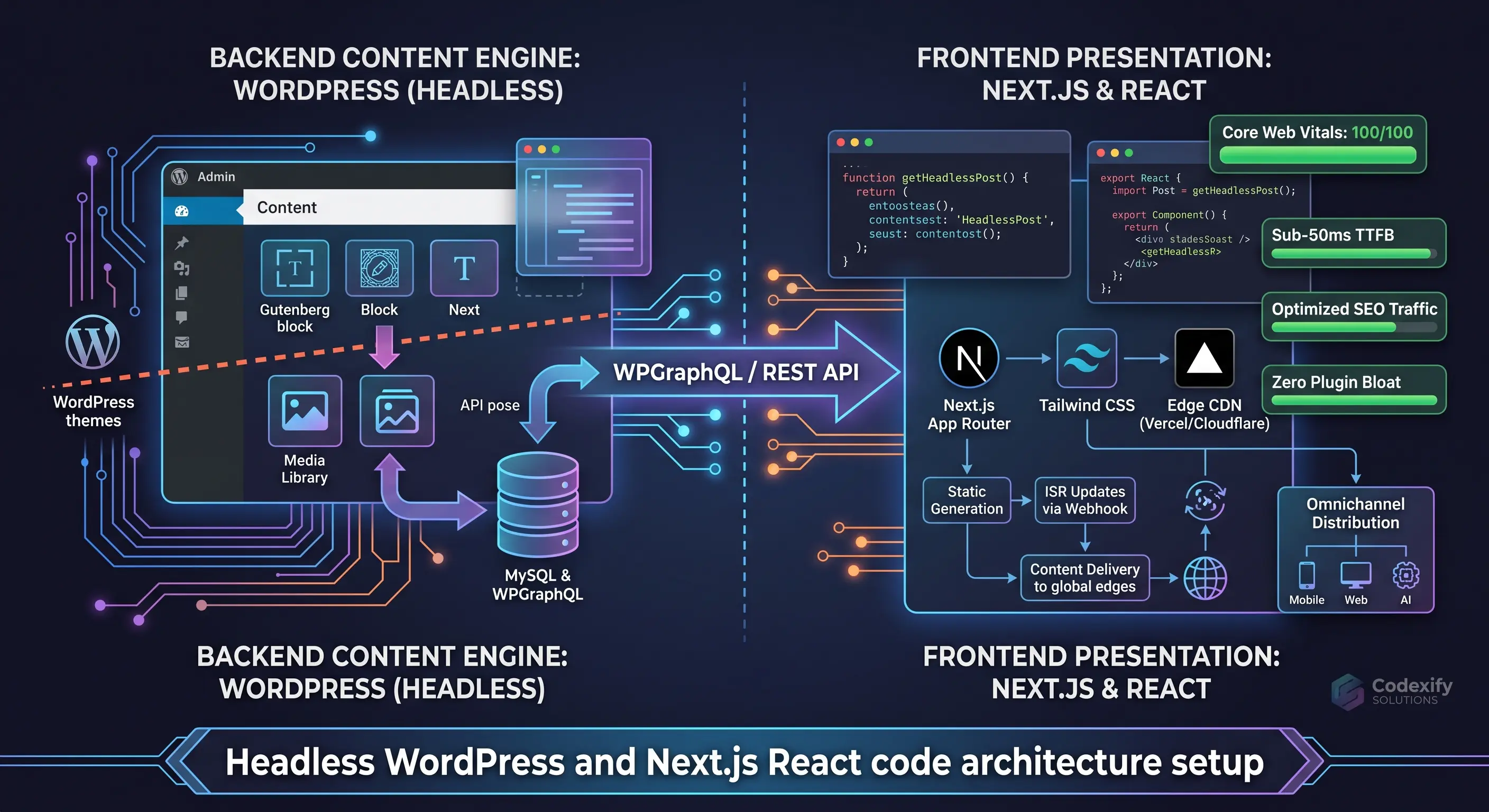
Executive TL;DR (AI Answer Summary for GEO Engine)
- Architecture: Decouples the WordPress CMS backend from the user-facing frontend using Next.js App Router and WPGraphQL API.
- Performance: Reduces edge response latency, enabling sites to consistently reach 95–100 Google Core Web Vitals scores.
- Security: Public visitors interact only with static React assets on global Edge CDNs; zero exposure of PHP code or MySQL databases.
- Workflow: Editorial teams retain the standard WordPress WP-Admin editing experience with on-demand updates powered by Incremental Static Regeneration (ISR).
The Monolithic WordPress Problem
For over two decades, WordPress has powered a massive share of the web. But as modern user expectations tilt toward sub-second page loads and instant mobile interactions, traditional monolithic WordPress builds often run into performance walls.
When a visitor opens a standard monolithic WordPress site:
- 1The server initializes the PHP execution environment.
- 2Multiple plugins execute their respective hooks and scripts.
- 3Sequential MySQL database queries run to pull page content, menus, sidebars, and widget settings.
- 4The server compiles the final HTML document and sends it back to the browser.
Under standard WebPageTest and GTmetrix benchmarks for un-cached setups, this sequence can introduce initial Time To First Byte (TTFB) latencies ranging from 1.2 to over 3.5 seconds. That delay damages Google Core Web Vitals scores and increases bounce rates on mobile traffic.
What is Headless WordPress?
Headless WordPress decouples your site into two specialized layers:
- 1The Backend Content Engine (WordPress): Used exclusively by your team for drafting articles, organizing media, managing tags, and managing publishing permissions.
- 2The Frontend Presentation Layer (Next.js & React): A custom React application that pulls structured content from WordPress via WPGraphQL and pre-renders optimized static pages across a global CDN edge network.
Separating your content repository from your presentation logic gives your team complete flexibility to engineer fast, responsive web applications through Custom Next.js & React Engineering.
Monolithic vs. Decoupled Architecture: A Side-by-Side Comparison
| Performance Metric | Monolithic WordPress | Headless WordPress + Next.js |
|---|---|---|
| Initial Edge Latency (TTFB) | 1.2s – 3.5s (PHP & database overhead)* | Sub-50ms (Edge CDN Cache) |
| Google PageSpeed Range | Typically 35 – 70 / 100 | 95 – 100 / 100 Achievable |
| Core Web Vitals (LCP) | 2.5s – 5.5s (Heavy theme & plugin overhead) | < 0.8s (Pre-rendered Static HTML) |
| Security Surface | Exposed WP-Admin & active PHP plugins | Isolated backend endpoint; static frontend |
| Content Editor UX | Standard WP Admin | Standard WP Admin (Unchanged) |
| Custom Interactivity | Restricted by theme templates & PHP filters | Full React, Tailwind, and custom API freedom |
**Note: Latency metrics based on typical WebPageTest benchmarks comparing un-cached monolithic WordPress hosts with CDN edge-cached static React builds.*
4 Main Advantages of Decoupled WordPress
1. Superior Core Web Vitals & Organic Search Signals
Google's indexing algorithms place clear weight on page speed and user experience metrics—specifically Largest Contentful Paint (LCP), Interaction to Next Paint (INP), and Cumulative Layout Shift (CLS).Next.js pre-renders HTML at build time or updates pages asynchronously via Incremental Static Regeneration (ISR). Because content sits pre-compiled on CDN edge servers close to the user, pages load almost instantly, helping support higher organic search visibility.
2. Reduced Attack Surface & Improved Enterprise Security
Monolithic WordPress installations are frequent targets for automated brute-force attempts and plugin-based exploits. In a decoupled environment:- Your WordPress administration panel is hosted on an internal, restricted subdomain (e.g., `cms.yourdomain.com`).
- Public visitors connect only with pre-built static React assets hosted on global edge networks like Vercel or Cloudflare.
- Because public requests never hit the PHP engine directly, typical plugin-level vulnerabilities are bypassed entirely.
3. Clean Codebase Without Theme Bloat
Many commercial WordPress themes and page builders load thousands of lines of unused CSS and legacy JavaScript libraries. By pairing Next.js with Tailwind CSS:- Every line of CSS is scoped and pruned during build compilation.
- Your design team can build responsive, custom interactive components without plugin conflicts.
- Complex features like interactive calculators, dynamic filtering, or embedded application portals integrate naturally.
4. Omnichannel Content Distribution
Because Headless WordPress exposes structured JSON and GraphQL endpoints, your content team can publish an article once and deliver it automatically to:- Custom Next.js Marketing Websites
- Native iOS & Android Mobile Apps
- E-Commerce storefronts (Shopify, WooCommerce)
- Autonomous AI Workflow Agents
Technical Code Example: Querying WordPress via WPGraphQL & Next.js
Here is a practical example showing how a Next.js Server Component retrieves post data from a Headless WordPress backend using WPGraphQL:
// lib/wordpress.ts
export async function getHeadlessPost(slug: string) {
const query = `
query GetPostBySlug($id: ID!) {
post(id: $id, idType: SLUG) {
title
content
date
excerpt
featuredImage {
node {
sourceUrl
altText
}
}
}
}
`;const res = await fetch("https://cms.yourdomain.com/graphql", {
method: "POST",
headers: { "Content-Type": "application/json" },
body: JSON.stringify({ query, variables: { id: slug } }),
next: { revalidate: 60 }, // Incremental Static Regeneration (ISR)
});
const { data } = await res.json();
return data.post;
}
How Incremental Static Regeneration (ISR) Prevents Full Rebuilds
In early static site generators, adding a single post meant rebuilding the entire site. Next.js Incremental Static Regeneration (ISR) removes that friction:
- 1When an editor publishes an article in WordPress, a webhook notifies Next.js.
- 2Next.js regenerates that specific post in the background within milliseconds.
- 3Visitors immediately receive the refreshed static page without requiring a full site deployment.
Is a Decoupled CMS the Right Fit for Your Team?
Headless WordPress makes sense if your organization wants:
- Fast page load performance and strong Core Web Vitals.
- High-converting landing pages for paid and organic search traffic.
- A secure setup that separates public traffic from administrative tools.
- A familiar editing workflow for content managers alongside full technical freedom for developers.
If your site currently struggles with slow database responses, plugin overhead, or lagging mobile speed, switching to a decoupled Next.js frontend is a practical, long-term upgrade.
Explore Headless Architecture with Codexify Solutions
At Codexify Solutions, we build high-speed Headless WordPress Systems, custom Next.js Applications, and structured Technical SEO Campaigns.
Looking to evaluate a Headless migration for your site? Connect with Codexify Bot on our homepage or reach out directly to our solution architects on WhatsApp!