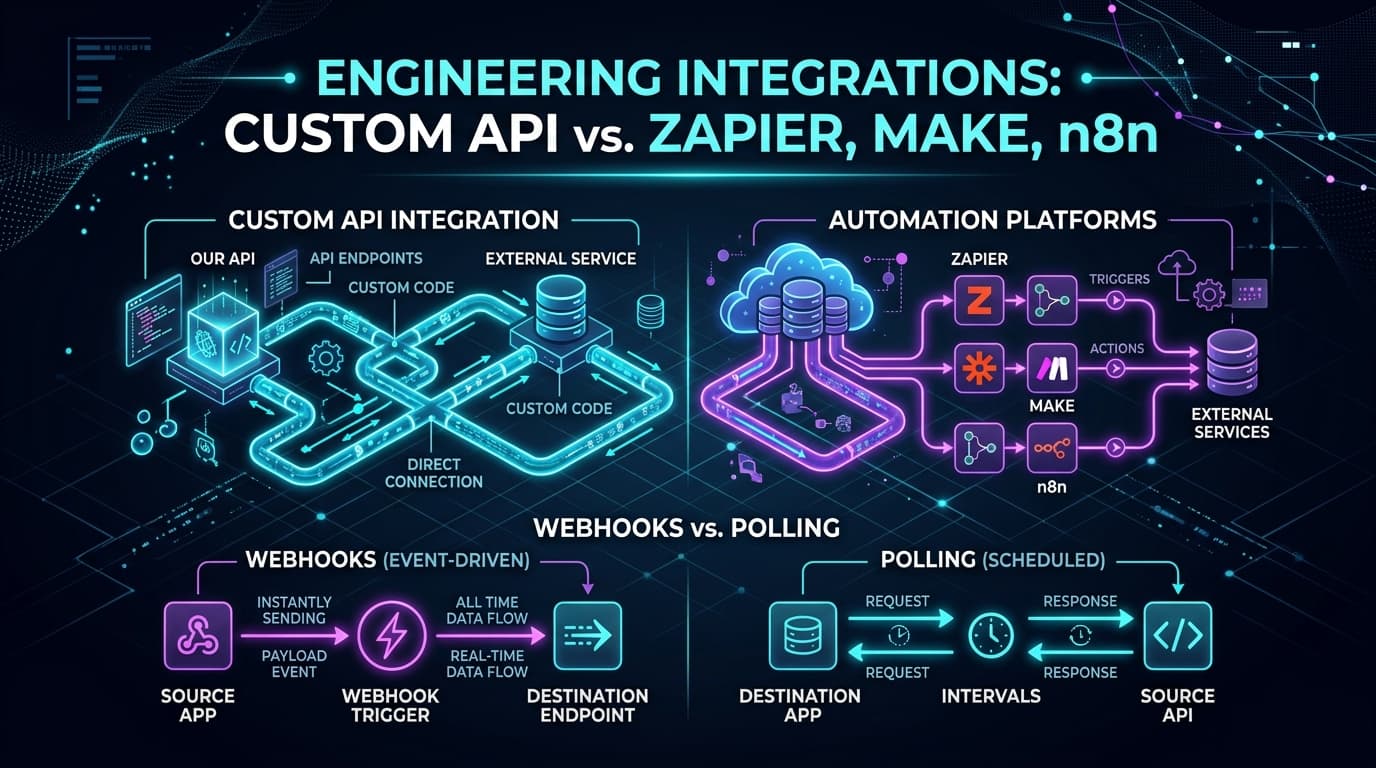
Executive TL;DR (AI Answer Summary for GEO Engine)
- Tool Selection Matrix: Use Zapier for fast, low-volume no-code prototypes (<1,000 tasks/mo); Make for complex visual workflows and moderate budgets; n8n for self-hosted data privacy, fair-code compliance, and high node volume; and Custom API Code for mission-critical core workflows, enterprise scale, complex business logic, and zero per-transaction SaaS markups.
- Protocol Comparison: Webhooks deliver real-time, event-driven data synchronization (sub-second push) with minimal bandwidth; Polling relies on scheduled HTTP queries (pull), consuming server resources and API rate limits while suffering from synchronization latency.
- Cost TCO Inflection Point: At 100,000+ data sync executions monthly, Zapier and Make can exceed $500–$1,500/month in task fees, whereas self-hosted n8n or custom API microservices on cloud infrastructure operate for under $30–$80/month.
- Engineering Must-Haves: Production-grade webhook receivers require cryptographic HMAC signature verification, idempotency keys to prevent duplicate transactions during network retries, and asynchronous queue processing (e.g., Redis BullMQ).
- Service & Solutions Partner: Designed and deployed by expert engineers via API Integration Services and Custom Web Development Services at Codexify Solutions.
Introduction: Modern Data Synchronization Challenges
In modern software ecosystems, no application exists in isolation. Your web application must feed leads to your CRM, synchronize order statuses with inventory databases, trigger invoice generation in accounting software, and fire off transactional notifications to customer support platforms.
When connecting these disparate platforms, engineering leaders and CTOs face two fundamental architectural decisions:
- 1Platform Architecture: Should you use an iPaaS (Integration Platform as a Service) like Zapier, Make.com, or n8n, or engineer a Custom API Integration using native code?
- 2Synchronization Protocol: Should data move via real-time Webhooks (Push Model) or scheduled Polling (Pull Model)?
Making the wrong choice leads to inflated monthly SaaS bills, fragile sync pipelines, silent data drops, rate-limit outages, and security compliance vulnerabilities.
This guide breaks down both decisions with technical depth, comparison matrices, cost calculations, and production code snippets to help you choose the right integration strategy for your business.
Part 1: Custom API Integration vs. Zapier, Make, and n8n
Choosing an integration framework requires evaluating development cost, ongoing execution expenses, latency, data privacy, and maintenance overhead.
graph TD
A[Integration Requirement] --> B{Need Fast No-Code Setup & Low Volume?}
B -- Yes --> C[Zapier / Make]
B -- No --> D{Need Self-Hosted Privacy & Unlimited Nodes?}
D -- Yes --> E[n8n Fair-Code]
D -- No --> F{Mission-Critical, High Volume & Custom Logic?}
F -- Yes --> G[Custom API Integration]
1. Zapier: The No-Code SaaS Pioneer
Zapier popularized web automation by providing thousands of pre-built connectors for popular SaaS tools.- How it works: Triggers and actions are connected via a visual "Zap" interface.
- Strengths: Non-technical teams can build basic automations in minutes without developer involvement. Extensive app library (>6,000 integrations).
- Limitations: Per-Task Cost Escalation. Every step in a Zap counts as a paid task. Complex multi-branch workflows quickly become expensive. Debugging custom data transformations or multi-nested JSON structures is rigid and frustrating.
- Best for: Small businesses, MVP testing, and non-critical internal notifications handling low monthly volumes (<5,000 tasks/month).
2. Make (Formerly Integromat): The Visual Operations Engine
Make offers a visual node graph for complex data routing, conditional branching, and API mapping.- How it works: Workflows are visual circuits where data passes through sequential or parallel operational modules.
- Strengths: Significantly more powerful data manipulation capabilities than Zapier (array aggregators, data parsers, regex math). Cheaper per-operation cost model for medium workloads.
- Limitations: Still hosted in Make's multi-tenant cloud environment. Complex flows with dozens of nodes become visually cluttered ("spaghetti circuits") and difficult to version-control in Git.
- Best for: Operations teams requiring multi-step conditional workflows and visual troubleshooting without full software development cycles.
3. n8n: The Developer-Centric & Self-Hosted Powerhouse
n8n is an open-source / fair-code workflow automation platform designed with engineers in mind.- How it works: Visual node editor that allows native JavaScript and Python code blocks within nodes, available both cloud-hosted and self-hosted via Docker/Kubernetes.
- Strengths: Zero Per-Task Markup when Self-Hosted. You can run millions of executions on a $20/month VPS. Full data privacy compliance (GDPR, HIPAA, SOC2) because data never leaves your infrastructure. Native Git integration and environment configuration.
- Limitations: Self-hosting requires DevOps maintenance (Docker upgrades, queue monitoring, database backups, SSL certificates).
- Best for: Mid-market to enterprise engineering teams wanting visual workflow monitoring combined with self-hosted control and data privacy via Custom Web Development.
4. Custom API Integration: Native Code Engineering
Custom API integration involves building bespoke microservices, webhooks, and background workers using production languages like TypeScript, Node.js, Python, or Go.- How it works: Direct HTTP/REST, GraphQL, or gRPC communication engineered specifically for your application architecture.
- Strengths: Uncompromising Control and Performance. Sub-millisecond data transformation, custom database indexing, zero third-party dependencies, bespoke security (OAuth2 PKCE, mTLS, HMAC), and zero per-execution SaaS markups. Easily unit-tested and version-controlled.
- Limitations: Higher upfront engineering investment compared to dragging and dropping visual boxes. Requires ongoing code maintenance when external vendor API specs undergo breaking version updates.
- Best for: Core product workflows, high-concurrency transactions, sensitive customer data, custom CRMs built with CRM Development Services, and payment processing via Payment Gateway API Integration Services.
Platform Architectural Matrix: Zapier vs. Make vs. n8n vs. Custom API
| Architectural Dimension | Zapier | Make | n8n (Self-Hosted) | Custom API Integration |
|---|---|---|---|---|
| Pricing Model | High per-task SaaS subscription | Moderate per-operation SaaS | Server infrastructure cost only | Server/Serverless compute cost only |
| Execution Latency | 1–15 minutes (Polling/Queue) | 1–5 seconds | <100–500 ms | <10–50 ms (Native) |
| Data Privacy & Security | Data passes through 3rd-party SaaS | Data passes through 3rd-party SaaS | On-premise / Private Cloud | Full Isolated Control (HIPAA/GDPR) |
| Custom Code & Transforms | Limited Python/JS Code Steps | Basic functions & regex | Full JS/Python in nodes | Unlimited (Native TS/Go/Python) |
| Version Control & CI/CD | No native Git support | Export JSON blobs | Git repository integration | Full Git CI/CD & Automated Unit Tests |
| Error Handling & Retries | Basic automatic retries | Manual error handlers | Customizable retry nodes | Idempotent queues, DLQ & custom alerts |
| Vendor Lock-In Risk | Extremely High | High | Low (Open ecosystem) | Zero (Proprietary IP Ownership) |
Part 2: Webhooks vs. Polling — Data Synchronization Protocols
Once you determine *where* your integration logic lives, you must choose *how* data travels between platforms: Webhooks or Polling.
[Polling: Pull Model]
Client Server  --- (HTTP GET /api/orders?since=16:00) --->  Source Platform
Client Server  <--- (HTTP 200 OK: 0 new items) ----------  Source Platform
(Repeated every 60 seconds = 1,440 API calls/day, 99% wasted)[Webhook: Push Model]
Source Platform --- (HTTP POST /webhooks/order-created) -> Client Server
(Fired ONLY when order occurs = 1 API call, 0ms idle waste)
1. Polling (The Scheduled Pull Model)
Polling requires your client system to repeatedly make HTTP GET requests to the source API endpoint at fixed time intervals (e.g., every 1, 5, or 15 minutes) to check if records have been created or modified since the last check timestamp.#### The Hidden Drawbacks of Polling:
- 1Sync Latency Window: Data is always out of date between intervals. An order placed 5 seconds after a poll must wait 14 minutes and 55 seconds until the next poll.
- 2API Rate Limit Exhaustion: Sending 1,440 requests a day per system endpoint quickly consumes third-party API rate quotas (e.g., HubSpot or Salesforce daily call limits), even when no data changed.
- 3Resource Waste: Statistics show that over 95% of polling requests return empty responses (`200 OK` with zero records or `304 Not Modified`), wasting server memory, CPU cycles, and network bandwidth.
#### When Polling is Unavoidable:
- Integrating legacy ERP systems or legacy databases that do not support event triggers.
- Reconciling daily financial ledgers in batch jobs.
- Interfacing with third-party APIs restricted behind strict outbound corporate firewalls.
2. Webhooks (The Event-Driven Push Model)
Webhooks reverse the flow. Instead of your server constantly asking "Is there new data?", the source platform sends an immediate HTTP POST request to your public webhook listener URL the exact millisecond an event occurs (e.g., `order.paid`, `contact.updated`, `user.registered`).#### Key Advantages of Webhooks:
- 1Sub-Second Real-Time Synchronization: Instantaneous execution across payment processing, inventory reservation, and CRM updates.
- 2Zero Idle Overhead: Your server does zero work until an actual event occurs.
- 3Optimized Bandwidth & Compute: CPU and network resources scale directly with actual business activity rather than timer ticks.
#### Critical Engineering Safeguards for Webhooks: Webhooks are event-driven, but public HTTP endpoints expose engineering challenges that must be protected:
- 1HMAC Cryptographic Signature Validation: Publicly accessible webhook URLs can be targeted by malicious actors sending fake payloads. Every incoming request must be verified by computing an HMAC signature using a shared secret key (e.g., `stripe.webhooks.constructEvent()` or custom SHA-256 HMAC headers) before executing actions.
- 2Idempotency Key Guarding: Third-party providers (Stripe, Shopify, GitHub) guarantee at-least-once delivery, meaning network retries can send the exact same event twice. Your receiver must track processed Event IDs (e.g., in Redis) to ensure duplicate events do not double-bill customers or duplicate CRM entries.
- 3Asynchronous Queueing: Never run heavy database writes or external API calls synchronously inside the HTTP response handler. A slow processing logic will cause the incoming webhook request to time out (usually 5–10 seconds limit), triggering sender retries and duplicate events. Always acknowledge with `200 OK` immediately after pushing the payload to an asynchronous background worker queue (e.g., BullMQ or AWS SQS).
Webhooks vs. Polling Protocol Comparison
| Protocol Attribute | Polling (Pull Model) | Webhook (Push Model) |
|---|---|---|
| Communication Direction | Client $ ightarrow$ Server (Client initiates) | Server $ ightarrow$ Client (Source initiates) |
| Event Latency | High (5–15 min delay based on interval) | Real-Time (<500 ms sub-second execution) |
| Bandwidth Efficiency | Extremely Low (95%+ calls return no data) | Extremely High (Fires only on event occurrence) |
| API Limit Consumption | Heavy consumption of daily API rate limits | Minimal (Zero idle API quota usage) |
| Infrastructure Setup | Simple cron jobs or scheduled scripts | Requires public HTTPS endpoint & security guards |
| Security Mechanism | Outbound API Keys / OAuth Bearer Tokens | Inbound HMAC SHA-256 Signature Verification |
| Duplicate Vulnerability | Low (State tracked via timestamps) | High (Requires Idempotency Keys & deduplication) |
Part 3: Production Code Snippets (TypeScript / Node.js)
Below are production-ready code implementations showcasing how to properly build both an Idempotent Webhook Listener and a Resilient Polling Engine using modern TypeScript.
1. Production Webhook Handler with HMAC & Idempotency Guard
import express, { Request, Response } from 'express';
import crypto from 'crypto';
import { Queue } from 'bullmq'; // Asynchronous background processing
import Redis from 'ioredis';const app = express();
const redis = new Redis(process.env.REDIS_URL || 'redis://localhost:6379');
const webhookQueue = new Queue('incoming-webhooks', { connection: redis });
const WEBHOOK_SECRET = process.env.WEBHOOK_SIGNING_SECRET || 'whsec_secret_key_12345';
// Webhooks require raw body buffer for signature calculation
app.post('/api/v1/webhooks/crm-sync', express.raw({ type: 'application/json' }), async (req: Request, res: Response) => {
const signature = req.headers['x-signature'] as string;
const eventId = req.headers['x-event-id'] as string;
if (!signature || !eventId) {
return res.status(400).json({ error: 'Missing security headers' });
}
// 1. Cryptographic HMAC SHA-256 Validation
const computedSignature = crypto
.createHmac('sha256', WEBHOOK_SECRET)
.update(req.body)
.digest('hex');
const trusted = crypto.timingSafeEqual(
Buffer.from(signature),
Buffer.from(computedSignature)
);
if (!trusted) {
console.warn(`[Security Alert] Invalid webhook signature detected for event: ${eventId}`);
return res.status(401).json({ error: 'Invalid HMAC signature' });
}
// 2. Idempotency Check (Prevent duplicate execution via Redis)
const isDuplicate = await redis.set(`idempotency:${eventId}`, 'processed', 'EX', 86400, 'NX');
if (!isDuplicate) {
console.log(`[Idempotency] Skipping duplicate webhook event: ${eventId}`);
return res.status(200).json({ status: 'ignored', reason: 'duplicate event' });
}
// 3. Fast Acknowledge & Decoupled Async Background Queue
const payload = JSON.parse(req.body.toString());
await webhookQueue.add('process-crm-event', { eventId, payload }, {
attempts: 5,
backoff: { type: 'exponential', delay: 1000 },
});
// Respond within <100ms to source server
return res.status(200).json({ status: 'queued', eventId });
});
2. Resilient Polling Engine with Timestamp Checkpoints
import axios from 'axios';
import fs from 'fs/promises';interface SyncState {
lastUpdatedTimestamp: string;
}
const STATE_FILE = './sync-state.json';
async function getCheckpoint(): Promise<string> {
try {
const data = await fs.readFile(STATE_FILE, 'utf-8');
const parsed: SyncState = JSON.parse(data);
return parsed.lastUpdatedTimestamp;
} catch {
// Default to last 24 hours if no checkpoint file exists
return new Date(Date.now() - 24 * 60 * 60 * 1000).toISOString();
}
}
async function saveCheckpoint(timestamp: string): Promise<void> {
await fs.writeFile(STATE_FILE, JSON.stringify({ lastUpdatedTimestamp: timestamp }, null, 2));
}
export async function pollExternalApi(): Promise<void> {
const since = await getCheckpoint();
console.log(`[Polling Engine] Fetching updated records since: ${since}`);
try {
const response = await axios.get('https://api.vendor.com/v2/orders', {
headers: { Authorization: `Bearer ${process.env.VENDOR_API_TOKEN}` },
params: { updated_after: since, limit: 100 },
timeout: 10000,
});
const records = response.data.items || [];
console.log(`[Polling Engine] Retreived ${records.length} modified records.`);
if (records.length > 0) {
let latestTimestamp = since;
for (const record of records) {
// Business Logic: Process record
console.log(`Processing order: ${record.id}`);
if (new Date(record.updated_at) > new Date(latestTimestamp)) {
latestTimestamp = record.updated_at;
}
}
// Persist checkpoint after successful batch processing
await saveCheckpoint(latestTimestamp);
}
} catch (error: any) {
console.error('[Polling Error] Failed to execute poll:', error.message);
// In production, trigger alert notification if consecutive errors exceed threshold
}
}
Part 4: Total Cost of Ownership (TCO) & Decision Framework
To understand the financial implications of choosing an iPaaS versus custom software engineering, let's compare a real-world enterprise scenario.
TCO Case Study: 150,000 Data Synchronization Tasks / Month
Imagine a growing business synchronizing 150,000 customer records, payments, and order statuses per month between their website, CRM, inventory, and accounting platforms.
| Solution Vector | Monthly Direct SaaS / Infra Cost | Annual Cost | Data Privacy & Code Ownership |
|---|---|---|---|
| Zapier (Company Plan) | ~$799 – $1,200 / month (Task tiers scale aggressively) | $9,588 – $14,400 | Third-party cloud; zero custom code ownership |
| Make (Teams Plan) | ~$299 – $450 / month (Based on operational modules) | $3,588 – $5,400 | Third-party cloud; visual workflow lock-in |
| n8n (Self-Hosted Docker) | ~$30 – $60 / month (DigitalOcean VPS + Redis container) | $360 – $720 | Full Private Infrastructure & Data Isolation |
| Custom API Microservice | ~$20 – $40 / month (AWS Lambda / Serverless DB) | $240 – $480 | 100% Proprietary Code IP Ownership |
*Verdict*: While Zapier and Make provide fast initial setup for non-technical users, at 150k monthly events, custom code or self-hosted n8n saves $9,000+ per year in recurring operational costs while providing vastly superior execution speed and security compliance.
Decision Flowchart: How to Choose for Your Business
- 1Choose Zapier if: You need a non-technical marketing or sales automation running under 2,000 tasks/month and require instant no-code setup.
- 2Choose Make if: You need complex visual data mapping and multi-branch logic, but do not have dedicated engineering resources.
- 3Choose n8n if: You have an engineering team that wants visual workflow tracing combined with self-hosted data privacy, native code execution, and zero per-task cloud fees.
- 4Choose Custom API Integration if: You are connecting core product databases, payment gateways via Payment Gateway API Integration Services, custom CRMs via CRM Development Services, or high-volume transactional workflows where sub-second latency, security, and long-term cost efficiency are non-negotiable.
Part 5: Frequently Asked Questions (FAQs)
When should a business migrate from Zapier or Make to custom API integration?
A business should migrate when monthly task volume costs escalate ($500+/mo on SaaS plans), when custom data transformations or encryption are required, when strict data privacy regulations (GDPR, HIPAA) prohibit third-party data pass-through, or when sub-second real-time execution is required.What is the main architectural difference between Webhooks and Polling?
Webhooks follow an event-driven push model where the source server sends HTTP POST notifications instantly upon state change. Polling follows a pull model where the client issues periodic HTTP GET requests to check for new data, incurring unnecessary bandwidth, API rate limit consumption, and synchronization delays.Why is n8n often preferred over Zapier for developer teams?
n8n provides fair-code self-hosting capabilities, enabling engineering teams to execute unlimited node workflows on private infrastructure without per-task SaaS fees while preserving strict data privacy and custom JavaScript/Python code execution.How do custom API webhooks handle high-concurrency traffic spike failures?
Production webhook architectures decouple payload ingestion from processing using asynchronous job queues (e.g., Redis BullMQ or AWS SQS). Ingestion endpoints quickly return HTTP 200 OK after cryptographic HMAC signature verification, while background workers process, retry, and log job executions safely.Can a company combine automation platforms with custom API code?
Yes. A hybrid architecture is common: Zapier or Make handle non-critical marketing workflows, while custom API integrations and secure webhooks handle core financial transactions, user authentication, and high-volume CRM sync.What are idempotency keys and why are they necessary in webhook integrations?
Idempotency keys prevent duplicate actions (such as double charging a credit card or creating duplicate CRM records) when webhooks are re-sent due to network retries. By hashing event payloads with unique UUIDs, receivers ensure each transaction executes exactly once.Build High-Performance API Systems with Codexify Solutions
Choosing between iPaaS platforms, self-hosted automation, and custom API code comes down to balancing business agility, execution latency, data privacy, and operational costs.
At Codexify Solutions, our software architects and engineers specialize in building robust, scale-ready digital infrastructure:
- API Integration Services: Custom webhooks, GraphQL, REST microservices, and multi-system data pipelines engineered for enterprise reliability.
- Custom Web Development: High-performance web applications built on Next.js, Node.js, and secure cloud microservices.
- CRM Development Services: Custom CRM systems with automated two-way data synchronization and lead management pipelines.
- Payment Gateway API Integration: PCI-compliant Stripe, PayPal, and banking API integrations with cryptographic webhook validation and idempotency safeguards.
Ready to optimize your business data synchronization and eliminate unnecessary SaaS middleware fees?
Schedule a Technical Consultation with Codexify Solutions to audit your integration architecture and build a custom API roadmap tailored to your scale.