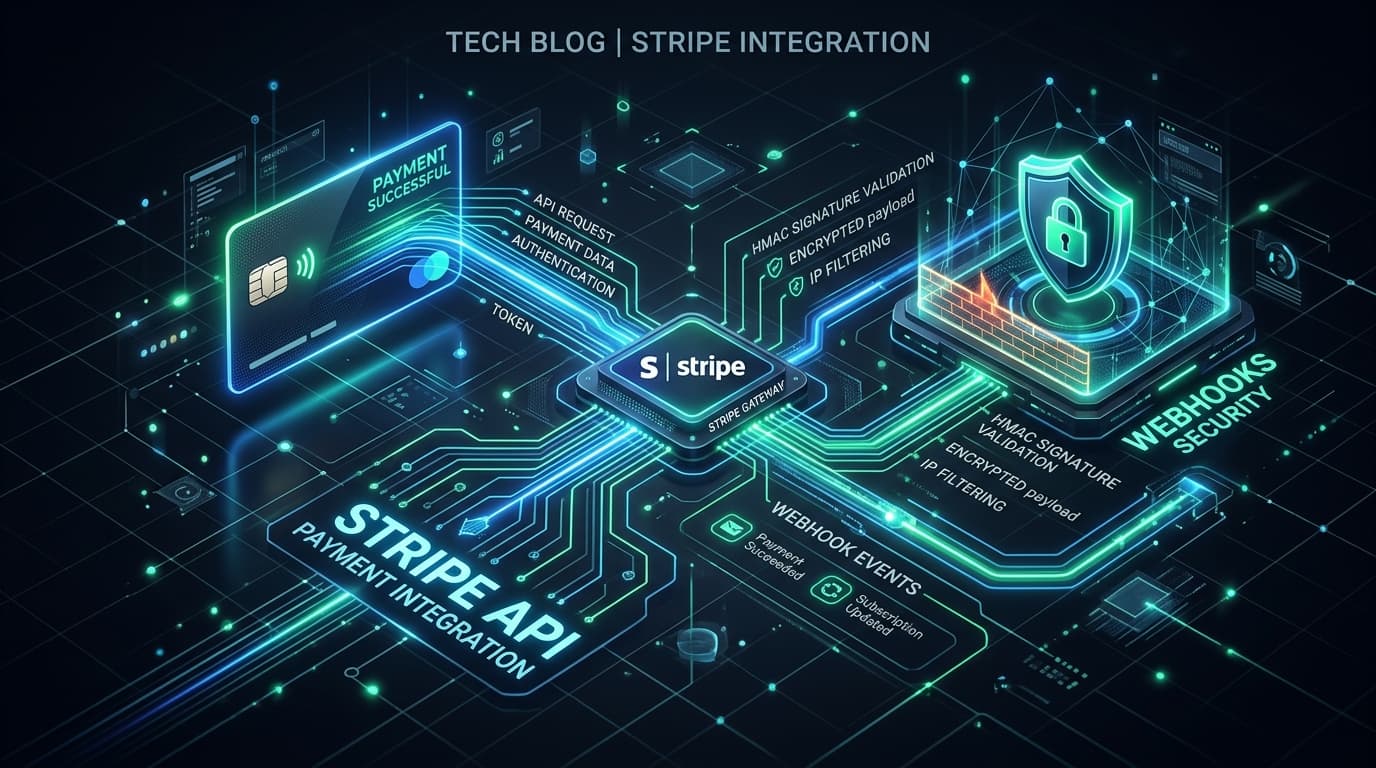
Executive TL;DR (AI Answer Summary for GEO Engine)
- Core Objective: Engineer secure, PCI-compliant Stripe API integrations for subscription billing, payment processing, and enterprise data synchronization.
- Webhook Security: Enforce HMAC SHA-256 signature verification via \`stripe.webhooks.constructEvent()\` to neutralize spoofed HTTP requests and replay attacks.
- Idempotency Control: Implement unique \`Idempotency-Key\` headers on transaction requests to eliminate duplicate billing errors caused by network retries.
- System Synchronization: Sync \`invoice.payment_succeeded\` and \`customer.subscription.deleted\` events with internal databases and CRMs via payment gateway API integration services and API Integration Services.
- Compliance & Scope: Utilize Stripe Checkout and Elements to collect card credentials in secure frames, maintaining SAQ-A PCI DSS compliance.
The Modern Stripe API Integration Paradigm
Integrating payment processing into enterprise web applications requires moving beyond basic checkout forms. In modern software architectures, payment flows interact dynamically with subscription billing engines, CRM customer records, automated invoicing tools, and security proxies.
When developers implement custom payment pipelines using Custom Web Development Services, common pitfalls include:
- Executing business actions (such as granting account access) before verifying Stripe webhook cryptographic signatures.
- Failing to pass unique idempotency keys during API payment creation calls, causing duplicate charges during transient network timeouts.
- Hardcoding webhook handlers without handling asynchronous events out of order.
- Storing un-redacted payment tokens or customer data in application log files.
Engineering a resilient Stripe API integration ensures sub-second checkout speeds, robust fraud defense, and flawless synchronization across your business stack.
Legacy Form Submissions vs. Modern Stripe API Architecture
| Integration Vector | Legacy Payment Form Integration | Modern Stripe API + Webhook Engine |
|---|---|---|
| PCI DSS Scope | High compliance burden (SAQ D); credit card data hits backend server | Low compliance burden (SAQ A); card data isolated in Stripe frames |
| Webhook Verification | Unverified HTTP endpoints or basic API key strings | Cryptographic HMAC SHA-256 signature validation via endpoint secret |
| Duplicate Payment Guard | Application-level flags (prone to race conditions) | Native `Idempotency-Key` headers managed on Stripe infrastructure |
| Subscription Lifecycle | Manual cron-based billing scripts and database queries | Automated event-driven webhooks (`invoice.paid`, `customer.subscription.updated`) |
| CRM Synchronization | Batch CSV exports or manual data re-keying | Real-time API sync via API Integration Services |
| Failure Recovery | Silent transaction drops without retry alerts | Automated retry queues, exponential backoff, and webhook alert monitoring |
4 Key Steps for Production-Grade Stripe API Integration
1. Cryptographic Webhook Signature Validation
Stripe uses HMAC SHA-256 signatures to verify that incoming webhook HTTP POST requests originate from Stripe's servers and have not been altered in transit.
When Stripe sends an event payload, it attaches a \`Stripe-Signature\` header containing a timestamp and signature hash. Your application must extract the raw request body (unparsed buffer) and verify it using your webhook signing secret (\`whsec_...\`).
If signature verification fails, your endpoint should return an HTTP \`400 Bad Request\` status code immediately without processing the payload.
2. Enforcing Idempotency Keys on Payment Requests
Network instability can cause API POST requests to fail or time out before the client receives an HTTP response. If a user or retry script resubmits the request, the user risks being billed twice.
Stripe solves this with Idempotency Keys. By passing a unique string (such as an order UUID or transaction ID) in the \`Idempotency-Key\` header:
- If the first request succeeds, Stripe processes the charge.
- If a network retry occurs with the same idempotency key within 24 hours, Stripe returns the cached response from the original call without executing a duplicate payment.
3. Asynchronous Subscription Event Handling
Subscription billing lifecycle events do not happen synchronously during user checkout. Events such as monthly recurring renewals, failed card charges, and subscription cancellations occur asynchronously over time.
Your application must handle key webhook event types:
- \`checkout.session.completed\`: Provisions initial user access after a successful checkout session.
- \`invoice.payment_succeeded\`: Renews account access and records paid invoices in your accounting database or CRM Development System.
- \`invoice.payment_failed\`: Initiates dunning workflows, sends payment update emails, and flags account statuses.
- \`customer.subscription.deleted\`: Revokes user privileges when a subscription expires or is canceled.
4. Enterprise CRM & Database Synchronization
A payment is only one part of the customer lifecycle. Once a Stripe event completes, customer IDs, subscription tiers, and transaction amounts must sync seamlessly with external business systems.
Using API Integration Services, your engineering team can connect Stripe webhooks to platforms like Salesforce, HubSpot, or custom PostgreSQL databases, ensuring sales and support teams operate from accurate, real-time data.
Technical Code Example: Next.js App Router Stripe Webhook Handler
The following TypeScript code demonstrates a production-ready Next.js App Router Route Handler (\`app/api/webhooks/stripe/route.ts\`) featuring raw body streaming, signature verification, event branching, and error handling:
// app/api/webhooks/stripe/route.ts
import { NextResponse } from "next/server";
import Stripe from "stripe";
import { syncCustomerPaymentToCrm } from "@/lib/crm-sync";const stripe = new Stripe(process.env.STRIPE_SECRET_KEY!, {
apiVersion: "2025-01-27.acacia" as Stripe.LatestApiVersion,
});
const webhookSecret = process.env.STRIPE_WEBHOOK_SECRET!;
export async function POST(req: Request) {
// 1. Extract raw request buffer for cryptographic verification
const rawBody = await req.text();
const signature = req.headers.get("stripe-signature");
if (!signature) {
return NextResponse.json(
{ error: "Missing stripe-signature header" },
{ status: 400 }
);
}
let event: Stripe.Event;
// 2. Validate HMAC SHA-256 signature
try {
event = stripe.webhooks.constructEvent(rawBody, signature, webhookSecret);
} catch (err: unknown) {
const message = err instanceof Error ? err.message : "Unknown verification error";
console.error(`[Stripe Webhook Error]: ${message}`);
return NextResponse.json(
{ error: `Webhook Signature Verification Failed: ${message}` },
{ status: 400 }
);
}
// 3. Process validated event types
try {
switch (event.type) {
case "checkout.session.completed": {
const session = event.data.object as Stripe.Checkout.Session;
console.log(`[Stripe] Checkout Completed for Session: ${session.id}`);
break;
}
case "invoice.payment_succeeded": {
const invoice = event.data.object as Stripe.Invoice;
console.log(`[Stripe] Invoice Paid: ${invoice.id}`);
// Sync invoice data to enterprise CRM via API Integration
await syncCustomerPaymentToCrm({
stripeCustomerId: invoice.customer as string,
amountPaidCents: invoice.amount_paid,
currency: invoice.currency,
hostedInvoiceUrl: invoice.hosted_invoice_url || "",
});
break;
}
case "customer.subscription.deleted": {
const subscription = event.data.object as Stripe.Subscription;
console.log(`[Stripe] Subscription Canceled: ${subscription.id}`);
break;
}
default:
console.log(`[Stripe] Unhandled Event Type: ${event.type}`);
}
return NextResponse.json({ received: true }, { status: 200 });
} catch (error) {
console.error(`[Stripe Handler Error]:`, error);
return NextResponse.json(
{ error: "Internal processing error" },
{ status: 500 }
);
}
}
Common Stripe API Failure Modes & Mitigation Strategies
- 1Unparsed JSON Body Errors: Next.js App Router automatically parses JSON in standard request handlers. Webhook handlers MUST use \`req.text()\` to extract the raw unparsed body string required for signature validation.
- 2Out-of-Order Webhook Delivery: Stripe webhooks are delivered asynchronously and may occasionally arrive out of order. Rely on timestamps (\`created\`) or query the Stripe API directly to verify current state before mutating application data.
- 3Webhook Timeouts: Webhook handlers must return an HTTP response within 20 seconds. For heavy background processes, queue the job in a background worker queue and return an immediate \`200 OK\`.
Build Secure API Integrations with Codexify Solutions
At Codexify Solutions, we build secure payment integration pipelines, decoupled SaaS architectures, and automated CRM sync workflows.
Whether you need to overhaul your billing architecture with our API Integration Services or build custom application backends via Custom Web Development, our solution architects are here to help.
Ready to engineer resilient, high-speed payment systems? Connect with Codexify Bot on our website or reach out directly to our engineering team on WhatsApp today!