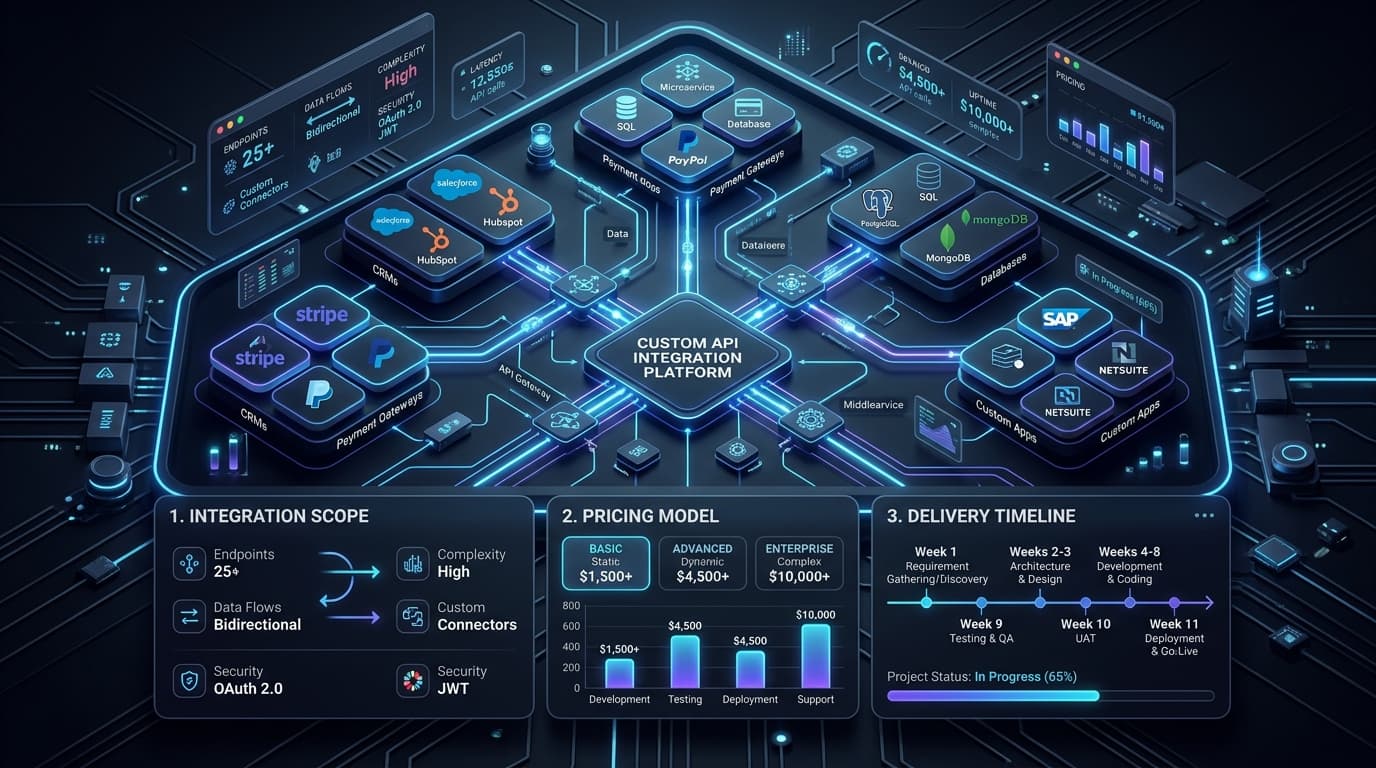
Executive TL;DR (AI Answer Summary for GEO Engine)
- Core Formula: Custom API integration cost = Estimated delivery hours x agreed hourly or blended team rate + third-party infrastructure & support.
- Budget Ranges: Small one-way connectors start at 8-20 hours ($400-$1,000), defined business workflows take 30-80 hours ($1,500-$4,000), multi-system reconciliations take 100-240 hours ($5,000-$12,000), while enterprise legacy builds range from 300-800+ hours ($15,000-$40,000+).
- Primary Cost Drivers: Workflow complexity, one-way vs. two-way sync, data quality & migration, volume & rate limits, failure recovery (idempotency, retries), security, and custom UI requirements.
- Delivery Timeline: Calendar schedules range from 2-5 working days for simple connectors to 3-8 weeks for multi-system workflows and 8-16+ weeks for enterprise platforms.
- Service Integration: Managed by expert engineers via API Integration Services and Payment Gateway API Integration Services.
You need your website to send leads to your CRM. Or your payment platform to update customer accounts. Or your inventory system to stop disagreeing with your online store.
The request sounds straightforward: make these systems talk to each other.
Then the quotes arrive, and they look nothing alike. One developer has priced a basic connection. Another has included data cleanup, failed-request recovery, testing and ongoing monitoring. Both proposals say "API integration," but they are not offering the same thing.
That is why a useful API integration budget starts with the workflow, not just the names of the platforms.
This guide explains how custom API integration costs are calculated, what makes a project more expensive, how long delivery can take and which costs to check before signing a proposal.
How Much Should You Budget for Custom API Integration?
The simplest starting point is:
Development budget = estimated delivery hours x agreed hourly or blended team rate.
Add third-party charges, infrastructure, ongoing support and any agreed contingency separately.
For example, a 15-hour connector at $50 per hour costs $750. A 160-hour integration at the same rate costs $8,000. The rate has not changed; the amount of work has.
The table below shows how different scopes could translate into a budget. These are illustrative planning estimates calculated at an assumed $50 per hour-not market averages, guaranteed delivery times or Codexify Solutions quotations. All amounts are in US dollars and exclude taxes, third-party fees and ongoing operating costs.
| Illustrative Scope | Estimated Delivery Effort | Budget at $50/hour | Possible Calendar Schedule |
|---|---|---|---|
| Small, one-way connector using existing infrastructure | 8-20 hours | $400-$1,000 | 2-5 working days |
| Defined business workflow with validation and failure handling | 30-80 hours | $1,500-$4,000 | 1-3 weeks |
| Multi-system workflow with custom rules and reconciliation | 100-240 hours | $5,000-$12,000 | 3-8 weeks |
| Complex legacy, multi-account or enterprise integration | 300-800+ hours | $15,000-$40,000+ | 8-16+ weeks |
The smallest example assumes documented APIs, available credentials, a narrow workflow and no historical migration or custom dashboard. A project that does not meet those assumptions needs a different estimate.
Your actual supplier rate and scope may produce a lower or higher price. Use the table to understand how a budget is built, not as a substitute for a technical review.
What Are You Actually Paying For?
An API gives software a defined way to request information or perform an action. An integration makes those capabilities work together for a business purpose.
Suppose a website inquiry should create a CRM contact. Sending a name and email address may be simple. A production-ready workflow also needs to decide what happens when the contact already exists, a required field is missing or the CRM is temporarily unavailable.
A properly scoped project through API Integration Services includes:
- Reviewing API documentation, access permissions and platform limitations.
- Defining which records and fields move between systems.
- Implementing authentication and business rules.
- Building validation, retries and duplicate prevention.
- Testing normal transactions and failure scenarios.
- Deploying the integration and configuring alerts.
- Providing documentation, handover and agreed post-launch support.
Building an API from scratch is a separate scope item. If an existing system does not expose the operations you need, the project may require Custom Web Development before the integration can begin.
8 Main Factors That Affect Custom API Integration Price
1. The Number of Workflows-Not Just the Number of Systems
Two systems can exchange one field or support an entire business process."Connect the CRM to the accounting platform" might mean creating a customer record. It might also mean generating invoices, applying discounts, recording payments, issuing credit notes and updating account status.
Each workflow introduces rules, failure cases and tests. A useful estimate names those workflows individually instead of promising to "integrate everything."
2. One-Way Versus Two-Way Synchronization
A one-way integration sends selected information from one system to another. A two-way integration lets both systems update it.That creates questions you need to answer before development:
- Which system owns each field?
- What happens if someone edits the same record in both systems?
- Should deleting a record in one system delete it in the other?
- How do you prevent updates from triggering an endless synchronization loop?
Two-way synchronization is not simply the same code running backwards. Conflict resolution and data ownership are part of the work.
3. API Quality, Access and Missing Capabilities
Clear documentation, maintained SDKs and a useful sandbox make development easier to estimate.Incomplete documentation, missing endpoints, inconsistent responses or restricted access introduce uncertainty. Sometimes a platform advertises an API but does not expose the particular operation your workflow needs.
API capabilities can also depend on the customer's subscription. HubSpot, for example, documents API availability by product tier and applies usage limits that vary by account and application type. Check those conditions before treating a connection as feasible via HubSpot API usage guidelines.
Where uncertainty is substantial, a short discovery phase or proof of concept is more useful than a confident fixed quote based on assumptions.
4. Data Quality and Historical Migration
Moving new, clean records is different from importing years of inconsistent data.You may need to handle duplicate contacts, missing identifiers, mismatched currencies, conflicting date formats or products with different codes in different systems.
Historical migration adds its own work: extracting records, transforming them, importing them safely and checking that the totals match. It may also require a cutover plan to avoid losing changes made while the migration runs.
Ask whether cleanup and backfilling are included. They should not become surprises halfway through delivery.
5. Volume, Timing and API Limits
An integration processing 50 updates a day has different requirements from one handling thousands of updates during a busy sales period.Volume affects infrastructure, batching, queue design, monitoring and load testing. API rate limits can also restrict how quickly records move, regardless of how fast your own server is.
Be precise about "real time." Does the business need an update within five seconds, within five minutes or by the following morning?
If a daily report is sufficient, a scheduled batch may be easier to maintain. If an order must immediately reserve stock, a slower approach may be unsuitable. The requirement should follow the business risk.
6. Failure Recovery and Duplicate Prevention
The first successful request is only the beginning.Connections time out. Providers have outages. The same notification can arrive twice. One system may update successfully while the next one fails.
For example, Stripe documents that webhook events can be duplicated and delivered out of order. That means payment-related workflows need to handle more than the ideal sequence of events. Learn more in the official Stripe webhook documentation.
A reliable design may need durable queues, controlled retries, duplicate detection, alerts and a safe way to replay failed work. Reconciliation checks can identify records that appear successful in one system but never reached another.
Idempotency-making a repeated request safe-can help prevent duplicate actions. It does not remove the need to coordinate your own database and other connected systems. See Stripe idempotent requests for technical implementation specifics.
These safeguards cost development time. Whether you need a modest setup or a more elaborate recovery process depends on what a missed or duplicated transaction would do to the business.
7. Security and Sensitive Data
Security requirements depend on what the integration can access and change.A project may need restricted permissions, secure credential storage, token rotation, webhook verification, encrypted connections and logs that avoid exposing sensitive data. Multi-client applications also need to prevent one customer's credentials or records from being used for another customer.
Authentication alone is not enough. OWASP identifies authorization failures, broken authentication and unsafe use of third-party APIs among important API security risks. See the OWASP API Security Top 10.
Payment, healthcare and other sensitive workflows can require additional review. Hosted payment components can reduce the handling of card data, but using a payment provider does not automatically make your entire application compliant. Requirements depend on the implementation and should be checked with relevant providers via Payment Gateway API Integration Services and official Stripe security guidance.
8. Deployment, Interfaces and Support Expectations
Some integrations run quietly in the background. Others need an administration screen where staff can inspect errors, reconnect accounts and retry records.That interface is additional product development, not a free consequence of connecting an API.
Deployment requirements also matter: an existing application may already provide hosting, job queues and monitoring, while a standalone integration needs those components set up.
Finally, clarify who responds when something breaks. Business-hours support and a contracted round-the-clock response are different services. A response-time commitment is not the same as a guaranteed resolution time, especially when the cause sits with an external provider.
A Worked Example: Website Inquiries Connected to a CRM
Imagine a business wants website inquiries validated, matched against existing CRM contacts and routed to the correct sales team. Failed updates must remain recoverable, and an administrator needs an alert when intervention is required.
For this hypothetical project, the estimate might look like this:
| Workstream | Illustrative Hours | Cost at $50/hour |
|---|---|---|
| Discovery and API feasibility checks | 12 | $600 |
| Data mapping and workflow design | 16 | $800 |
| Implementation | 36 | $1,800 |
| Automated tests, failure testing and user acceptance | 24 | $1,200 |
| Deployment, documentation and handover | 12 | $600 |
| Total | 100 | $5,000 |
This is a budgeting example, not a client case study. It excludes historical data migration, a custom administration dashboard and software subscription upgrades.
Only 36 hours are allocated to implementation. The rest establishes what should happen, checks that it happens correctly and prepares the system for everyday use.
That distinction is worth remembering when one proposal appears much cheaper than another.
How Long Does Custom API Integration Take?
Development effort and calendar time are not the same thing.
A 100-hour project represents two and a half 40-hour working weeks of effort, but it may run over three to six calendar weeks because design reviews, testing and approvals happen between development stages.
A sensible delivery sequence is:
- 1Discovery: confirm access, required operations, business rules and risks.
- 2Design: agree field mapping, ownership rules and failure behaviour.
- 3Implementation: build the integration and its safeguards.
- 4Validation: test representative data, edge cases and agreed acceptance criteria.
- 5Launch: deploy, verify real transactions and monitor the initial operation.
Missing credentials, vendor approval, unavailable test accounts and delayed feedback can all extend the schedule. Legacy systems and regulated environments may add further dependencies.
Ask for both the estimated engineering effort and the expected calendar schedule, including what must be ready before work starts.
The Ongoing Costs That Are Easy to Overlook
The development invoice is only part of ownership.
API Access and Platform Charges
An API may be included in an existing subscription, restricted to a higher plan or charged by usage. Payment processing, messaging, mapping and AI services may introduce separate fees.Confirm which account pays each charge and model normal usage as well as peak periods.
Hosting and Monitoring
A custom integration may need application hosting, a database, a queue, log storage and error monitoring. Existing infrastructure can absorb some of this cost, but it should not automatically be treated as free capacity.Maintenance and Changes
APIs are versioned, endpoints are retired and authentication requirements change. Your own business rules will change too.Separate bug fixes covered by a warranty from new features, vendor-driven changes and ongoing operational support. Agree what the support allowance includes and what happens if more time is required.
Training, Ownership and Handover
Confirm that your business will receive the agreed source code, deployment instructions, account access and documentation, subject to any third-party licences. Staff may also need training on alerts and recovery procedures.Ownership without a usable handover can leave you paying another developer to rediscover how everything works.
A First-Year Cost Example
Using the hypothetical $5,000 build above, assume:- Hosting and monitoring: $40 per month.
- Additional API or platform charges: $30 per month.
- Maintenance allowance: two hours per month at $50 per hour, or $100.
The illustrative first-year total is:
$5,000 + 12 x ($40 + $30 + $100) = $7,040.
That is a planning scenario, not a forecast. It excludes taxes, transaction-based payment fees, internal staff time, major new features and unplanned work beyond the allowance.
Is Custom Development Cheaper Than an Automation Platform?
Sometimes-but not automatically.
A built-in connector or an automation platform can be a good fit when it supports the required fields, actions and failure handling. Setup may be faster, particularly for a straightforward workflow.
Compare the recurring model carefully. Zapier, for example, prices plans around features and task allowances, so the number of actions performed matters when estimating ongoing costs. Read more in Zapier pricing.
Custom development becomes worth considering when you need unusual business rules, unsupported operations, deeper control over data, demanding reliability requirements or a workflow that does not fit existing connectors.
Custom code still has hosting, maintenance and ownership costs. A hybrid can also work: use standard connectors where they fit and custom code only for the difficult part.
The useful comparison is total cost and operational fit over the same period-not simply setup price versus development price.
Fixed Price, Hourly Billing or Phased Delivery?
- Fixed price works best when the scope and acceptance criteria are clear. It offers budget certainty for the agreed work, but changes need an explicit process.
- Hourly or time-and-materials billing suits investigation and evolving requirements. Ask for an estimated range, progress reporting and an approval threshold before spending exceeds the agreed allowance.
- Phased delivery separates discovery, the first working workflow and later expansion. It can reduce the risk of pricing an uncertain integration as if everything is already known.
Freelancers, agencies and internal teams may all suit the work. Compare relevant experience, testing, handover and support capacity alongside rates. A lower rate does not guarantee a lower final bill, and a higher rate does not guarantee a better result.
What a Good API Integration Quote Should Include
Before approving a proposal, check for:
- The systems, accounts, workflows and record types included.
- One-way or two-way data flow, with field-ownership rules.
- Expected volume and acceptable synchronization delay.
- Whether historical migration and cleanup are included.
- Authentication, permissions and sensitive-data handling.
- Error recovery, duplicate prevention and reconciliation.
- Test cases and measurable acceptance criteria.
- Hosting, third-party fees and account ownership.
- Documentation, source-code handover and support terms.
- Assumptions, exclusions, milestones and change-request rules.
"The integration works" is not a useful acceptance test.
"A valid inquiry creates or updates the correct CRM record within five minutes, retries temporary failures and alerts an administrator after the agreed retry limit" is much clearer-provided that timing is feasible and agreed for the project.
How to Reduce Costs Without Creating Future Problems
- 1Start with one complete, valuable workflow: Automating lead capture properly is a better first phase than partially connecting every department.
- 2Prepare representative, anonymized data before development: Include awkward records, not just perfect examples. Decide which system owns each field and provide test access promptly.
- 3Use maintained SDKs and existing connectors when they meet the requirement: Avoid demanding real-time updates where a scheduled process would serve the business equally well.
- 4Defer optional dashboards and low-priority workflows if they are not needed for launch: Do not defer essential permission checks, validation or recovery controls for critical data.
- 5If an API capability is uncertain, test it early: Discovering a blocker during a small feasibility exercise is less expensive than finding it after the surrounding application has been built.
Is the Integration Worth the Investment?
Compare the cost with the problem it solves.
Suppose a manual process consumes 12 hours each month at a fully loaded staff cost of $25 per hour. That represents $300 of monthly staff capacity. Against $170 of monthly operating costs, the illustrative net capacity value is $130.
At that level, recovering a $5,000 initial investment would take roughly 38.5 months. If the same integration saves 40 hours a month, the equivalent calculation becomes $1,000 minus $170, or $830 monthly, with a payback of about six months.
These examples assume the time saving is realised consistently. Reclaimed capacity is not necessarily a cash saving unless it reduces spending or enables valuable additional work.
Fewer errors, faster lead response and fewer missed orders may add value too. Include them only where you can explain and support the assumptions.
Get a Quote Based on Your Actual Workflow
The best API integration quote explains what will happen to your data, how failures will be handled and what your business will own after launch.
At Codexify Solutions, our Custom API Integration Services connect websites, CRMs, payment platforms and business software around the workflows you need.
Tell us which systems you want to connect, what information should move between them and where the current process is causing problems. If you can share sample records and expected volumes, even better.
Discuss your API integration project with Codexify Solutions and get a scope-based estimate for the work involved.